Pages

Showing posts with label TeslaMate. Show all posts

Friday, October 23, 2026

So, How is the Tesla Now? Part 2: The Telemetry Truth

     Welcome back to Part 2 of my 3-part retrospective on approaching 50,000 miles in our 2023 Tesla Model Y. In Part 1, I covered rationing our final 137.2 warranty miles before a $500 inspection and the painful rev-lag of driving our Honda Odyssey all week; today, we are digging into my Home Assistant and TeslaMate telemetry before Part 3 wraps up with Full Self-Driving, Elon Musk, and whether I would buy another Tesla right now.  I am pretty sure I will have more to say about this after the inspection is done, but as I'm trying this format of writing a bunch of posts and scheduling them to be published, I haven't dropped it of yet, so tune back in next week for that part.

     Anyway... back in August 2023 (at 1,014.5 miles), I spun up TeslaMate alongside Home Assistant to log every drive locally. There is a side quest there about the drama around the original developer of TeslaMate leaving the project and having to spin up a separate docker container and database to host it outside of home assistant; however, I'm not getting into that here (maybe that will be a future topic).  So, across 6,838 drives and 48,848 tracked miles, I collected some data!

     In that time, the car pulled 20,833.4 kWh from the wall (18,546.0 kWh into the battery after 11% charging overhead), averaging 427 Wh/mi wall-to-wheel (380 Wh/mi driving). Even after Puget Sound Energy raised rates from 13.88 cents to (15... 18...) 21.66 cents per kWh (the 3 biggest increases in electricity rates in their history!), our entire 3.5-year electricity total is $3,249.22; working out to 7.6 cents per mile at home (86.9% of our charging) and 8.4 cents per mile if you include the $849 spent at superchargers across the country. Battery degradation stayed boringly flat too, easing from 278.7 rated miles new to around 260 to 266.8 miles today (just 4.3% to 6.5% loss).

     Meanwhile, our 2018 Honda Odyssey usage completely collapsed. Before the Tesla arrived, the Odyssey averaged 1,068 miles per month at 19.3 MPG (costing 22 to 23.9 cents per mile). Once the Model Y took over at 1,289 miles per month, the minivan dropped 74% to just 276 miles per month. Driving those Tesla miles in the Odyssey would have burned 2,531 gallons for $11,023.14 - meaning the Model Y saved us $7,233.60 in fuel and kept 22.4 metric tons of CO2 out of the air (even more if you add in the costs for oil changes).

     In the winter, the Model Y AWD is a beast in the snow. We logged 30 ski trips (4,390 miles) up to Stevens Pass down to 13.9 F without needing a Supercharger on a full home charge. Around 35,000 miles, we swapped the factory tires (Pirelli Scorpion MS) at Costco for EV-optimized tires (Bridgestone Turanza EV) before ski season; they are quieter than both the factory tires and the Odyssey's tires (Michelin CrossClimate2), though the Bridgestone tires seem to have traded away about 14% in range (moving winter consumption from 404 Wh/mi to 467 Wh/mi).

     For longer trips, we can drive non-stop from Seattle to Vancouver, BC on a 100% charge and arrive with nearly 42% left.  Enough to get us around Vancouver for the day before topping off at one of the local superchargers (those BC superchargers are even cheaper than charging at home FYI).  Last summer, when a ferry issue forced us south through Olympia and Aberdeen to camp at Bogachiel State Park (575 miles with a roof rack and ski box full of camp gear and four bikes on the hitch rack), I plugged into the Forks Supercharger past midnight while the kids slept; recharging from 27% to 78% and decompressing before pitching the tent at 1:00 AM (while a shorter 337-mile Fort Flagler camping trip only needed a very short public charging stop to top off). Even the scary 12V battery error we saw in Worthington, Minnesota during our 5,531-mile winter trip to Michigan was just a quirk from using a bad CCS charging adapter at a third-party station... and Lynnwood Tesla Service checked on it and found nothing wrong, but gave me a Model S loaner overnight.

     The telemetry is hard to argue with; gas cars can't even compete.  I have also found most of the fear mongering is just plain false (waiting forever to charge, eating tires, range anxiety - which we did have that with Renmin's old Nissan Leaf 12 years ago - all that is just noise now.)  Even the Insurance issue, which was a real problem when we first got our Tesla (Progressive doubled our insurance twice!)  but now we found out that some insurance companies were just milking the hype to make a quick buck - we pay the same rate now we did before the Tesla.  

So, I'm pretty sure I went way over 500 words here.  So tune in next week for Part 3, we need to talk about Elon Musk's software changes, Full Self-Driving's personality quirks, and my final buying verdict.

Later,

     SteveO

Monday, October 23, 2023

The Test Trip V1


     Over the past couple of months, we have been getting used to mostly driving an electric car.  It has become clear that our daily driving needs are more than met by having a Tesla and charging at home over night.  Our normal daily activity can actually be exceeded with a 110v 15 A mobile charger, but having a 220v 48A wall connector gives us flexibility to guarantee we can fully charge a completely drained battery over night.  So, at this point, I am trying to put myself into a situation where I need to charge;  technically, I didn't really do that yet, but I was a little nervous testing the limits of the battery while taking my family through a mountain pass with occasional drops in cell phone reception.

     So, to keep this kind of data focused, I created a Grafana Dashboard for the trip.  The dashboard itself was 99% created by TeslaMate, and I filtered the data from the time I parked my car the night before until I got home.  I included just a couple minutes of charging after I got home to make sure I had the final battery percentage in the tables.  I hope you enjoy!  


     So, moving to the trip, my original plan was to charge the battery to 100% over night, drive over a 4,000ft mountain pass to the village of Leavenworth that is about 100 miles away, charge at that location while hanging around town for the day, then drive home along the same route. It turns out, as soon as my kids learned they can watch shows on the screen while parked at a charger, they insist that we let them watch as soon as we plug in.  This was okay with me, as it gave me some time to get out, stretch my legs, and walk into a nearby market that actually had normally priced products.  There were 13 chargers at the station, and only about 5 of them were occupied by vehicles charging.  One was occupied by someone who parked their Tesla at the charging station but was not charging their car.  Very rude, and poor etiquette.

The total trip distance turned out to be 221 miles, and it cost me about $13.90 for electricity.  By contrast, if we had made the same trip in our Honda Odyssey, the 11 gallons of gas would have cost us about $55 based on local gas prices, which hover around $5/gal if you shop at Costco or a grocery store.  As I'll cover a little when going over the charging, you will see I could have cut nearly 25% off of the electricity costs if I were more aggressive with my battery.


     I had set the wall adapter to charge the car as slowly as possible the night before.  I don't know if this actually matters, but I have never charged the car to 100% before, and wanted to put as little stress on the battery for this first trip.  It ended up taking around 10 hours to charge, but I could have done it in 3 or 4 hours if I maxed out my Tesla Wall Adapter.  You may also notice that when I charged in Leavenworth, I added 30% capacity to the battery, and I returned home at the end of the day with 43% capacity.  This means I did not need to charge the car at all that day, and I could have either completed this trip on a single charge; meaning I could have saved $3 by charging at home compared to using the charger in Leavenworth.  Alternatively, I could have charged the battery to 80%, and put less wear and tear on the battery by not charging to 100%.  So, it turns out this trip, which apparently a lot of people think is too long for a day trip, 
 

     Here I take a look at my battery state of charge for the trip.  I had gone a couple days before the trip without charging, which is why the battery was under 40% the night before, and you can see I slowly charged the battery over night.  This was done by setting the charger Amperage to try and target my originally scheduled departure time of 8AM; as usual, the family did not like to wake up in the morning, so our actual departure time was a couple hours later.  Our power usage increased steadily as we traveled over the mountain pass, then leveled off after crossing Steven's Pass.  The majority of the time, we were traveling 55-60MPH the entire time, but I don't think anyone would be surprised to hear that mountains effect battery consumption.  We charged up in Leavenworth before parking and hanging around town for the day.  Finally, you can see on our way home, we used a lot of battery initially on our way up the pass, and actually regained about 3% going down the other side.  The weather was dark and fogging going down the west side of the pass, so we actually slowed down to around 45MPH.  Regenerative breaking was used to maintain speed, and this resulted in a little boost.


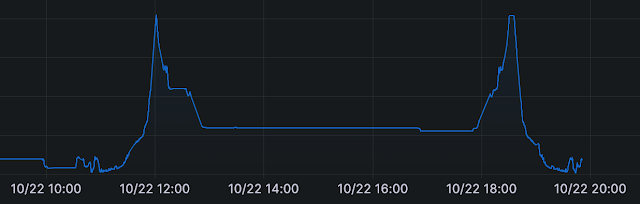
     Finally, here is the elevation chart.  I cut off the left side because it was a long line sitting at 387 feet.  You can see the mountain pass was about 4,000 ft high, and Leavenworth is about 1,100 ft in elevation.  you will also notice right around noon, we stopped at a rest area for the kids.  Like I have read many others report, we need to stop for bathroom breaks far more often then we need to stop and charge the car. You can also see while in Leavenworth, we moved the car down by the river at about 17:00 so the kids could play in the park for about an hour before we drove home. 

     In conclusion, the Tesla was perfectly suited for this type of trip.  I also have no doubt that most electric cars these days would have a similar experience.  There is an Electrify America charging station just a couple blocks away at a grocery chain across the river from the Tesla chargers, but I didn't actually investigate to see if it was good.  I will also noticed that several hotels in the area have destination chargers, which could be nice if you were staying overnight; however I have no experience with that.

     In hindsight, I think I should choose a slightly more challenging route for a road trip in preparation for our cross country journey.  Maybe something with an overnight stay that requires stopping to charge in both directions to reach our destination.  We also primarily drove 2 lane highways for this trip, and I've heard that Interstate highway travel uses more battery.  So, until the next phase in my electric car journey, I will go back and plan something.

   One final note about the driving experience.  As I commented to my wife at one point, the Tesla pretty much drove itself on Basic Autopilot for the entire trip.  I had my hand on the wheel, and there were 2 or 3 disengagements where I didn't like the way the car was handling some of the sharper turns, and I often found myself uncomfortable with how close to the center line the Tesla would drive.  I am confident it was just keeping the car centered in the lane, but I do prefer hugging the outside line when going 60mph on a 2 lane road; I just don't trust the other people to stay on their side that much.  However, the basic autopilot functionality did surprisingly well on those curvy mountain highways.

So, that's all for now.  I will start planning for a longer road trip, but I'm really starting to feel good about this cross country trip!


Later,

     SteveO